
Recognizing the potential impact of our business activities on our ecosystem, we have taken steps to maintaining our commitment to protect biodiversity in our areas of operation.
In accordance with the “Komatsu Earth and Environment Policy,” Komatsu has been actively engaged in biodiversity conservation and restoration activities across all of its global business sites. These efforts are promoted not only by Komatsu but also in cooperation with suppliers, customers, and partners, with their support for the policy.
Recognizing that its business activities both depend on and impact biodiversity, Komatsu promotes conservation and restoration initiatives from two main perspectives.
First, the company continues to steadily advance its long-standing efforts to reduce the environmental impact of its operations. In addition, Komatsu has made it mandatory to consider biodiversity in land use decisions, such as during the construction of factories.
Second, Komatsu directly engages in biodiversity conservation and restoration through its “One Site, One Theme” initiative, which also aims to raise employee awareness by encouraging site-specific consideration of local ecosystems.
In response to evolving societal expectations, Komatsu refers to the framework of the Taskforce on Nature-related Financial Disclosures (TNFD) and applies the LEAP approach to identify and assess nature-related dependencies, impacts, and risks across its overall business activities. Based on these assessments, Komatsu is further strengthening its efforts to conserve and restore biodiversity.
In alignment with international frameworks such as the Convention on Biological Diversity, Komatsu complies with relevant laws and regulations of each country in which it operates, including those prohibiting illegal logging, and actively works to conserve and restore biodiversity in its operational regions. From 1992 to 2006, Komatsu carried out a reforestation project in Indonesia. Since then, we have continued our collaboration with local communities through initiatives such as transferring seedling cultivation technologies, distributing cuttings, managing experimental forests, and hosting local students and international researchers.
In addition, through Komatsu’s resource-circulating business Reman (remanufacturing), we are steadily promoting the reuse of recovered materials and the restoration of former mining sites, thereby contributing to environmental impact reduction through our business activities.
Also, in 2021, Komatsu conducted a questionnaire survey across the Komatsu Group to identify future challenges and confirm the direction of future initiatives, while reviewing biodiversity conservation activities.
The results of the survey, showing the status of each site’s activities, are provided below.
Looking ahead, Komatsu will continue working to expand biodiversity conservation and restoration efforts throughout the entire life cycle. To this end, Komatsu will explain these activities to members of its supply chain and encourage their proactive participation in these initiatives.

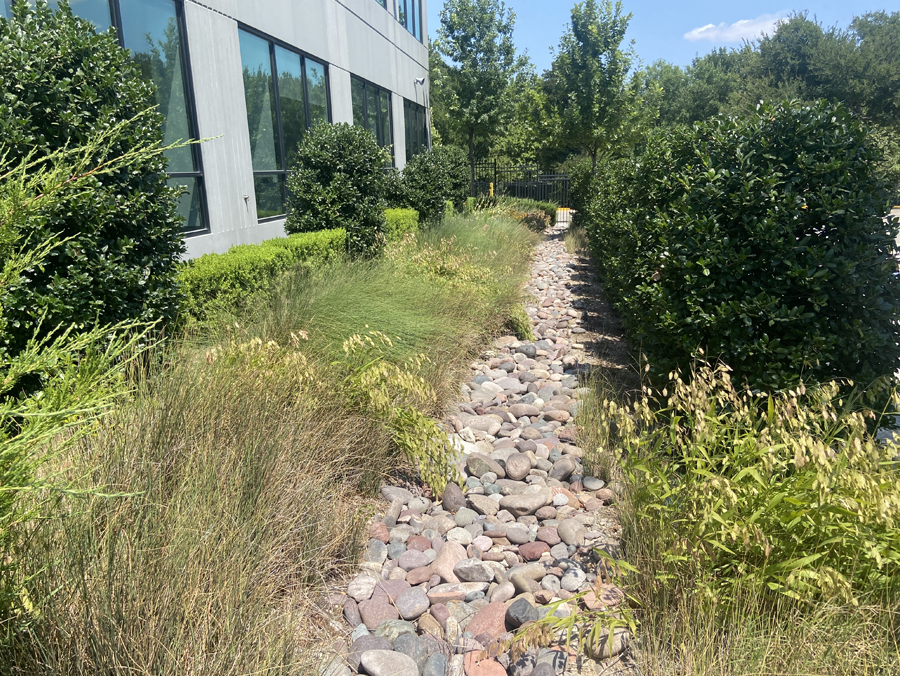


【United States】Hensley Industries, Inc. (Activity location: Dallas, Texas)
In 2019, as part of the effort to obtain LEED Silver certification* for an office building, Hensley Industries installed a bioswale, a vegetated rainwater infiltration strip. Initially, drought-resistant native grasses suited to the local environment were planted, and the area was operated as an initiative for stormwater management and greening.
Later, to further address local nature-related challenges, part of this area was converted in 2025 into a pollinator garden, a garden that supports insect pollination. In Texas, bee populations are facing a serious decline due to factors such as drought, extreme weather, pesticide use, and habitat loss, and a decline of approximately 61% was reported in 2025.
Against this backdrop, Texas native wildflowers suitable not only for drought tolerance but also for insect pollination were planted in this area. This helped address the decline in bee populations. In addition, bare ground and dead wood were provided to create nesting habitats. Because many bees in Texas are solitary and nest underground, creating such habitats is important to the effectiveness of the initiative. The pollinator garden also contributes by providing nectar sources for migrating monarch butterflies.
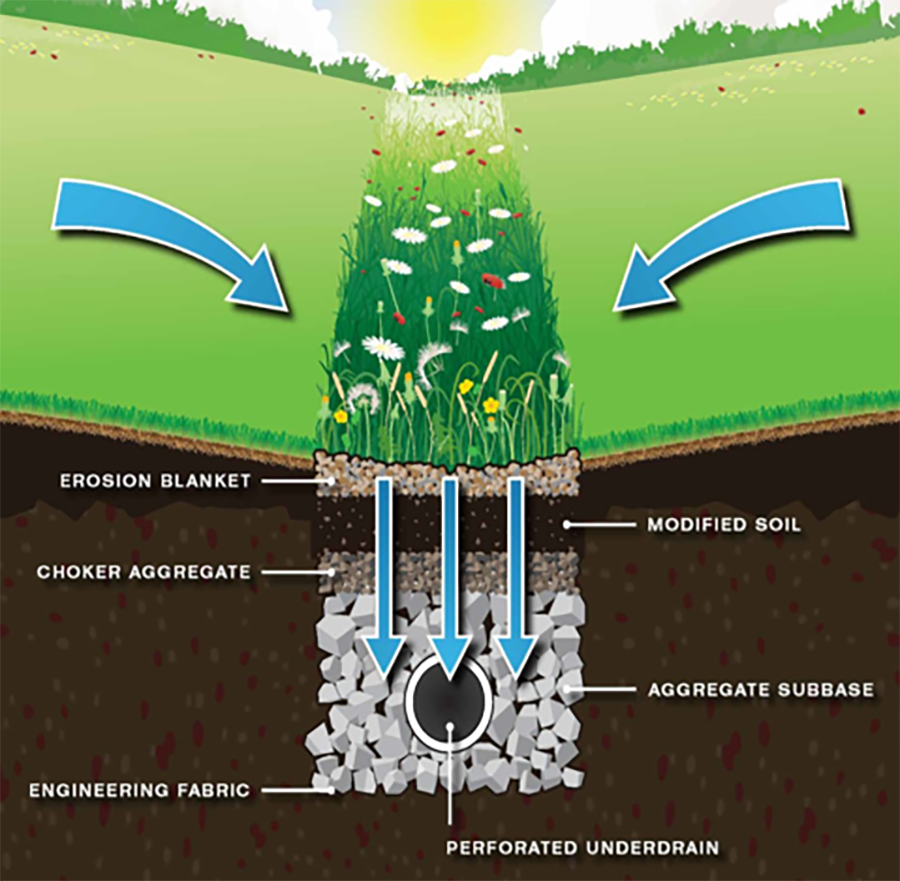
A shallow landscaped channel with perforated pipes installed at the bottom and covered with rocks and vegetation. Rainwater is filtered through soil and gravel layers, and plants slowly absorb moisture, thereby reducing total runoff while replenishing groundwater resources.