

"Reman" is short for "Remanufacturing," meaning regeneration.
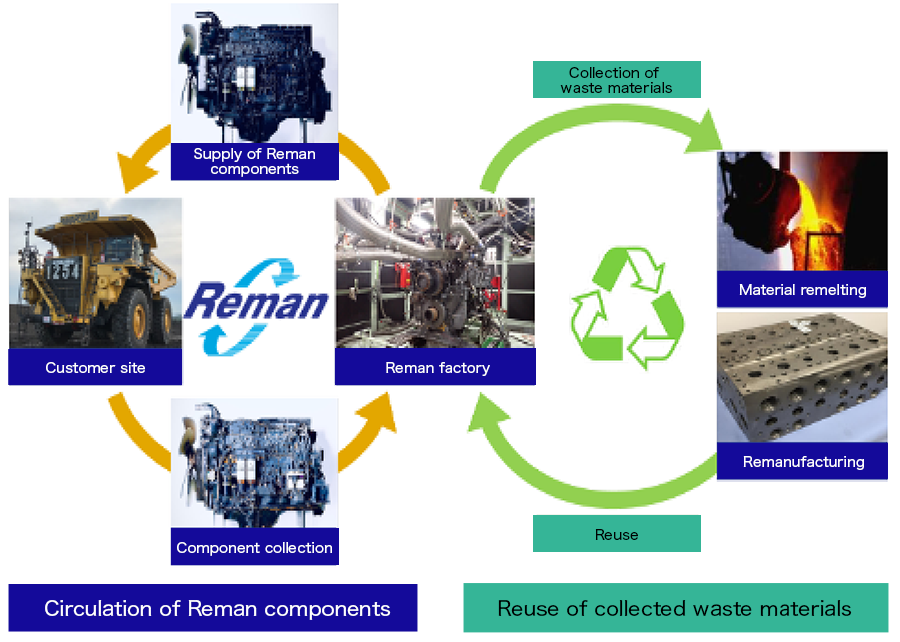
This business involves collecting components from construction and mining equipment that has been in operation for extended periods. These components are then remanufactured at Reman plants to restore them to a like-new condition and provided to customers in line with their overhaul timing, including disassembly, inspection, and repair. Mining equipment, which is the primary focus of the Reman business, is typically used for approximately 10 to 25 years after purchase. Over its lifecycle in terms of total operating hours, repairs of parts and overhauls involving two to five component replacements are essential.
Reman products offer the same level of quality as new components, but at a lower cost. Komatsu's Reman business continues to grow as a resource-circulating business that contributes to environmental conservation while also helping customers reduce their lifecycle costs.
The Reman business model leverages Komatsu’s strength in developing and manufacturing key components such as engines, transmissions, and motors in-house. This enables components to be remanufactured according to the original design and production specifications, resulting in Reman products that are competitive in terms of quality, lead time, and cost. In addition, information such as component durability obtained during disassembly is fed back to the development division to support product development, quality improvement, and enhanced serviceability.
The Reman business creates value not only for customers, but also for the global environment, distributors, and Komatsu.
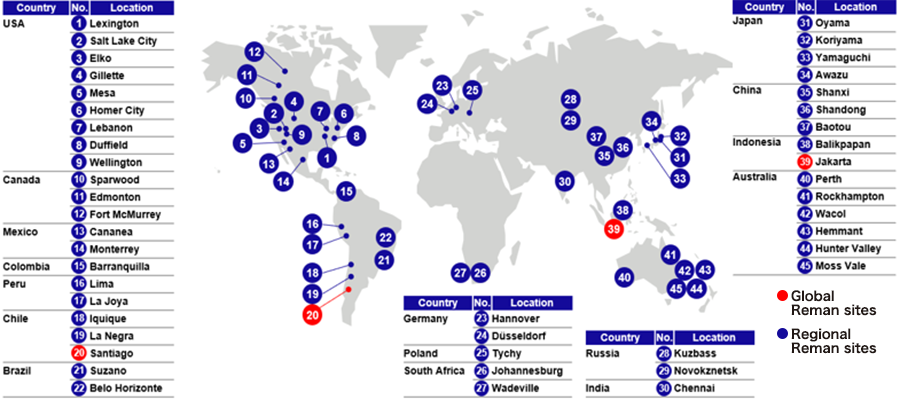
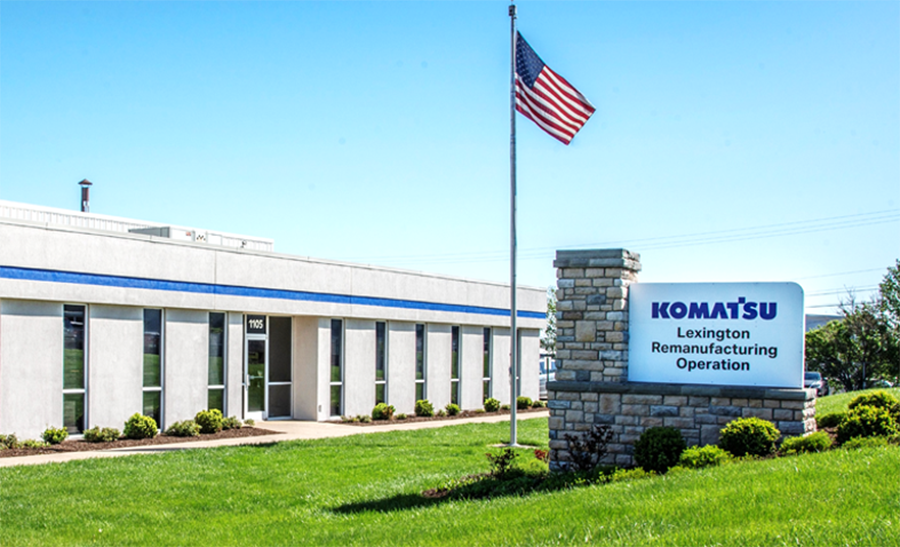
Komatsu, through its wholly owned subsidiary Komatsu America Corp. (Headquarters: United States; President and CEO: Kozo Okuda), acquired the remanufacturing business assets for components and parts for construction and mining equipment from SRC of Lexington, Inc. (Headquarters: Lexington, Kentucky, U.S.A.; President & General Manager: Rob Shear; hereinafter “SRC of Lexington”) in February 2025.
SRC of Lexington was established when Komatsu transferred its Reman business in North America in 2009, and has continued to do business with Komatsu as one of the most important suppliers for its North America Reman business. This acquisition was made to respond to growing demand for Reman products, driven by the increase in the installed base of quarry and mining equipment sold in North America since 2010, and to strengthen Komatsu’s global supply capacity for Reman products.
By newly securing its own dedicated Reman facility in North America, one of the world’s largest markets for construction and mining equipment, Komatsu will further strengthen its Reman business in North America, enhance its supply capacity to meet growing global demand for Reman products, and further expand the business.
Komatsu is working on the conservation and effective use of limited resources by reusing critical materials used in products, etc.
An increasing number of diesel engines, which are used in construction machines, are now equipped with exhaust gas processing devices to reduce the density of NOx (nitrogen oxide) and PM (particulate matter) in exhaust gases. The exhaust gas processing devices use noble metals as a catalyst to reduce the density of NOx and PM. To effectively use these resources, for example, Oyama Plant in Japan collects exhaust gas processing devices that have been replaced to maintain their performance on construction machinery in operation, and either recycles the noble metals contained in them or reconditions the devices so that they can be reused. In this way, Komatsu promotes the effective use of critical materials and reduces the consumption of new critical materials.
Komatsu promotes “zero-emission” initiatives to reduce waste generation and effectively utilize the waste generated through recycling.
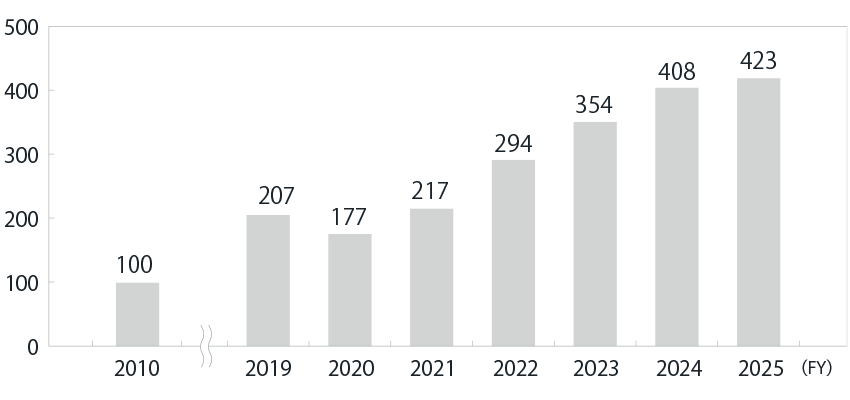
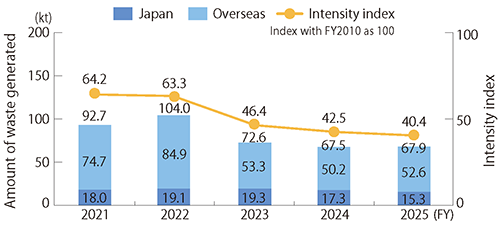
At its production sites in Japan, Komatsu works to convert waste plastics into valuable materials, reduce wood waste by improving transport packaging configurations, and reuse packaging materials. At its overseas sites, Komatsu also actively promotes the reuse of waste through proper segregation. In FY2025, Komatsu promoted the effective use of sand used in casting processes and reduced plastic waste, including packaging materials, resulting in a significant reduction in waste generated. As a result, waste generation intensity decreased by 60% compared with FY2010.
| Item | FY2025 | Target of FY2030 |
|---|---|---|
| Index of waste generated per unit (Reference year: 2010) |
40 | 38 |
Amount of waste generated
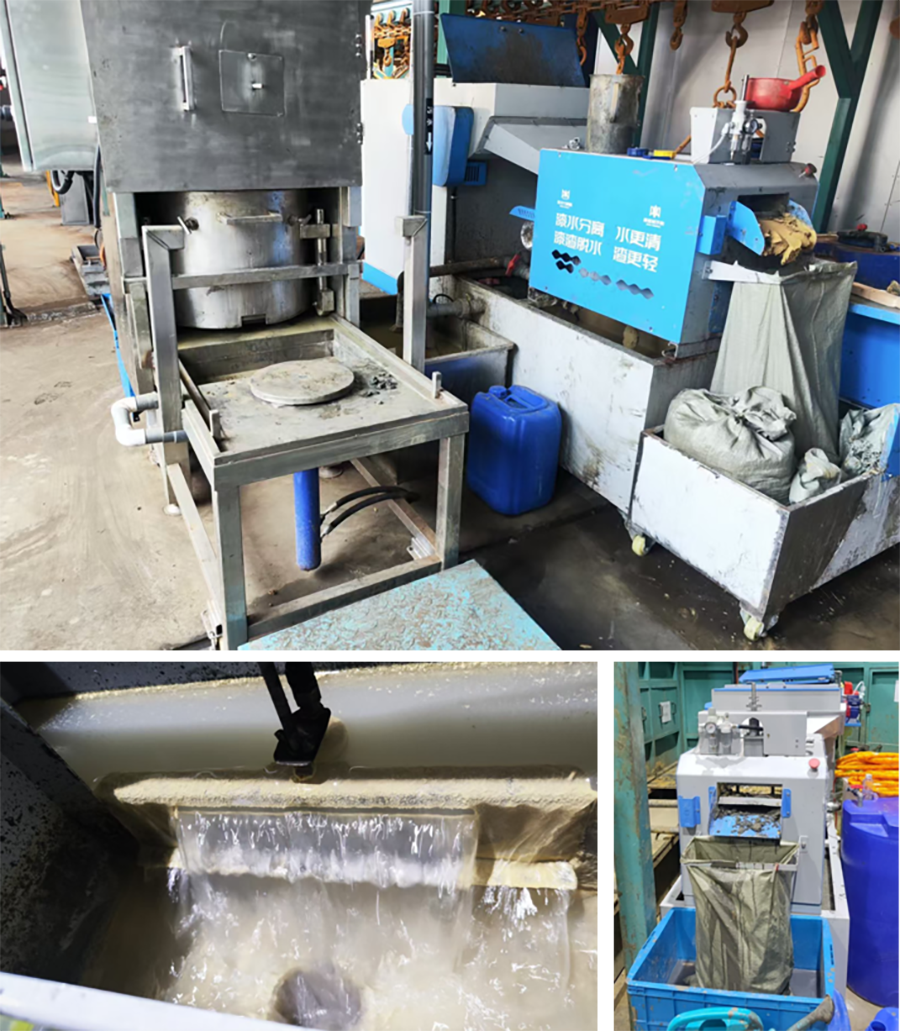
At the foundry of Komatsu (Changzhou) Construction Machinery Corp. (KCCM) in China, large volumes of water-based paint are used for painting parts. Paint mist collected by the exhaust gas cleaning equipment in the paint booths dissolves into the circulating water and becomes viscous over time. As the concentration of paint components in the circulating water increases, it interferes with the operation of the treatment system. For this reason, the circulating water was previously replaced approximately once every two weeks. This wastewater had to be treated as hazardous waste, resulting in increased waste volume. In addition, because new water had to be supplied to replace the discharged wastewater, water consumption also increased, creating a situation with a high environmental impact.
To address this issue, KCCM introduced circulating water treatment equipment for wet paint booths and established a system to filter, separate, and collect paint sludge from contaminated water, allowing the clean filtered water to be reused. The collected paint sludge is dewatered through a two-stage compression process using compression equipment, making it possible to significantly reduce the amount of waste generated.
Based on the Chinese cultural concept of “開源節流” (kaiyuan jieliu),” meaning securing and conserving resources, KCCM will continue to actively promote initiatives to reduce environmental impact and make effective use of resources.
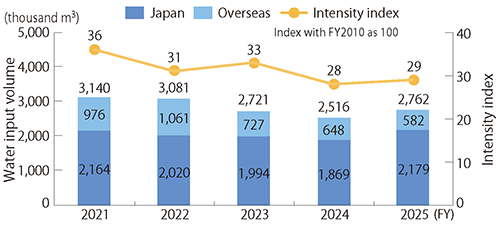
Recognizing that Komatsu’s plants in the Hokuriku area of Japan use particularly large amounts of water, Komatsu continues to optimize water use for snow melting purposes during winter, while improving water efficiency in production processes—such as recycling cooling water and converting water-cooled systems to air-cooled ones—in order to reduce the volume of newly introduced water.
In FY2025, Komatsu significantly reduced the total water input compared to the previous year, achieving a 71% reduction in water input intensity compared to FY2010.
| Item | FY2025 | Target of FY2030 |
|---|---|---|
| Water Input Intensity Index (Base year: 2010) |
29 | 30 |
Water input volume
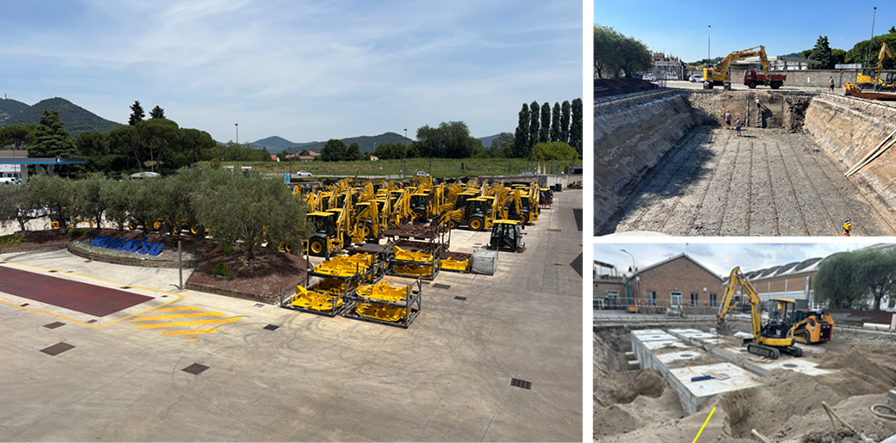
To reduce the amount of newly introduced water used in production processes, Komatsu Italia Manufacturing S.p.A. (KIM) promoted a project to collect and reuse rainwater at its plant. KIM installed rainwater collection and storage equipment with a capacity of 130 m³ on the plant premises. The collected rainwater is properly treated using water treatment equipment and then used in processes such as painting and machine washing.
Water used in these processes can be reused multiple times through repeated treatment and filtration. It is ultimately discharged as plant wastewater, but is properly managed in accordance with relevant laws and regulations and permit conditions. This helps reduce the use of new water resources and promotes the sustainable use of limited water resources.
Although the amount of rainwater collected depends on precipitation, rainwater use has maintained stable and favorable results since the start of operation. This project embodies KIM’s initiatives to reduce environmental impact and improve resource efficiency, and represents an important step toward building a sustainable production system.
Amid concerns that extreme weather is becoming increasingly common, Komatsu will continue to promote initiatives to reduce environmental impact and make effective use of resources. Komatsu will also continue to actively pursue activities that create opportunities for environmental improvement, with the aim of realizing a sustainable society.