
Our business partners are important members of our value chain, who supply the materials, parts and components necessary for the continued operation of our manufacturing enterprise. At Komatsu, we aim to build a Win-Win relationship with our business partners by making interactive efforts under a relationship of mutual trust. Along with the expansion of our global operation, our supply chain has also been expanding all over the world. Taking seriously the recent gain of momentum for the spread of CSR in the overall supply chain, we are working to realize CSR procurement globally by being proactive in providing intense support for the CSR initiatives of our business partners.
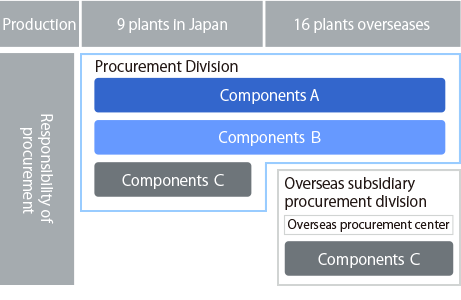
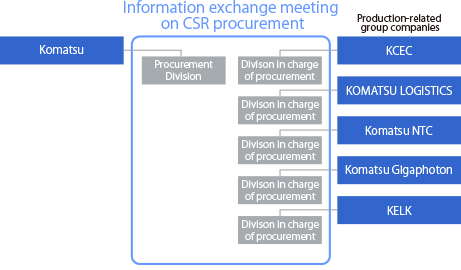
Komatsu employs a centralized procurement system where the Procurement Division deals with almost all the components and materials used in multiple plants in Japan. For overseas production, A- and B-category components as specified in the component categories described above are dealt with by the Procurement Division, and the C components are dealt with by the procurement departments of overseas subsidiaries. In addition, we have established an overseas procurement center within each site in the U.S., Europe, China, and Asia to ensure the penetration of the policies of the Procurement Division and ensure the consistency of the procurement activities of each overseas subsidiary. We are also using this system for global supply chain management and the promotion of CSR procurement. Furthermore, we hold meetings to exchange information with the procurement departments of production-related group companies on a regular basis to respond to common issues on a group-wide basis.
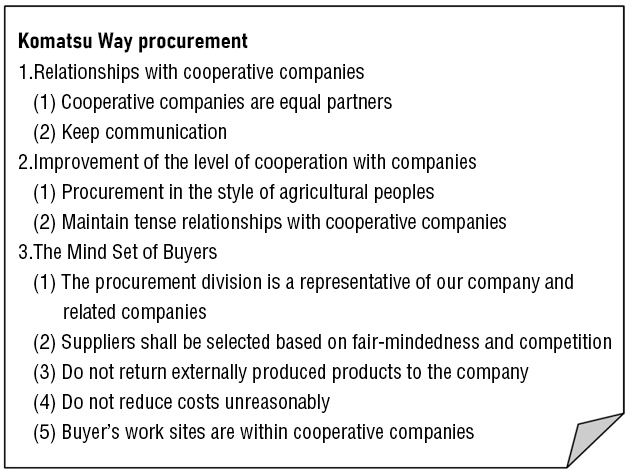
Developing procurement staff responsible for CSR procurement is also a key issue. The Komatsu Way – Procurement Edition outlines essential fundamentals for promoting global procurement, especially the core principles and code of conduct to keep in mind when working with partner companies. In addition, we have been facing significant changes in laws and regulations of Japan and other countries on business transactions, employment and labor, environmental protection, export control and other matters. Responsible persons from the procurement department are required to understand these trends and reflect them appropriately in their daily procurement activities. In 2025, Komatsu conducted compliance refresher training and human rights education for approximately 500 managers and other employees in the procurement division. This training aimed to update their understanding of CSR procurement and share the importance of further raising awareness across the entire division. Going forward, Komatsu continues to ensure thorough understanding through group training and e-learning tailored to each job class, from new employees to managers.
Komatsu’s basic production policy is to manufacture products in the regions where they are in demand, and 50 of its 62 plants related to construction and mining equipment are located overseas.
For components, parts, materials, and other items, we are proactively promoting local procurement based on production and procurement policies established according to the characteristics of each item. In particular, for B and C components, we aim to achieve globally optimal procurement by expanding cross-sourcing among regions so that we can respond flexibly to changes in the trade environment, such as exchange rate fluctuations, FTAs and EPAs, and import/export regulations.
Production and procurement policies for components and parts used in construction and mining equipment
| Category | Definition | Production and procurement policy | Examples of parts |
|---|---|---|---|
| Components A | Key components for differentiation that determine product quality and functions | Permanent development and production in Japan (supply from Japan to the world) | Engines, transmissions, axles, hydraulic equipment, and electronic equipment |
| Components B | Components that we need to purchase intensively from certified suppliers from the viewpoints of functions, quality, and investment | Optimal procurement from 2 or 3 regions in the world | Cabs, floor parts, cooling components, undercarriage parts, cylinders, high-pressure hoses, tires, rims, and operator’s seats |
| Components C | Parts with relatively low levels of technological difficulty, which should desirably be produced or procured close to the assembly plant | Local procurement | Thick/ thin sheet-metal parts, machined parts, and cast and wrought products as materials |
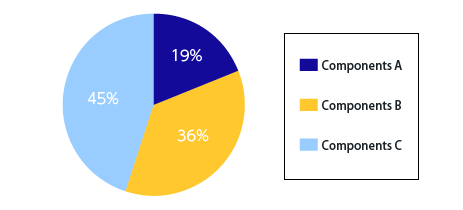
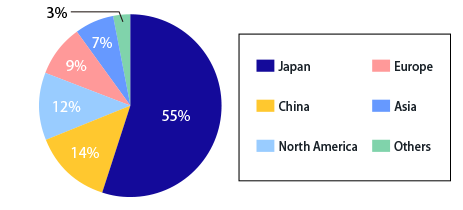
The breakdown of procurement in monetary terms in the construction and mining equipment business of the Komatsu Group in FY2023 is shown below.
Components Types by Percentage of Procurement in Monetary Terms
Origin of components by Percentage of Procurement in Monetary Terms
In its construction, mining and utility equipment business, Komatsu does business with approximately 2,500 suppliers (Tier 1 suppliers) worldwide. From among these suppliers, Komatsu selects priority suppliers through a screening process that considers ESG-related, country-specific, industry-specific and product-specific risks, as well as business relevance.
Among these priority suppliers, Komatsu selects those considered particularly important based on assessments of factors including their management fundamentals, including top management’s philosophy; their SLQDC performance in business with Komatsu, including development and proposal capabilities; the importance of the items they supply from procurement strategy and technical perspectives; and the history and scale of their business with Komatsu. The companies selected through this process constitute Midori-kai.
Midori-kai currently operates in five regions: Japan, China, Thailand, North America and Europe. Procurement from Midori-kai member companies accounts for 74% of Komatsu’s total procurement by value in FY2025. Each regional Midori-kai works in collaboration with Komatsu’s production plants in the region to promote activities that leverage local characteristics. Through regular meetings, each regional Midori-kai also promotes a better understanding of Komatsu’s business and encourages active communication between Komatsu executives and the top management of member companies.
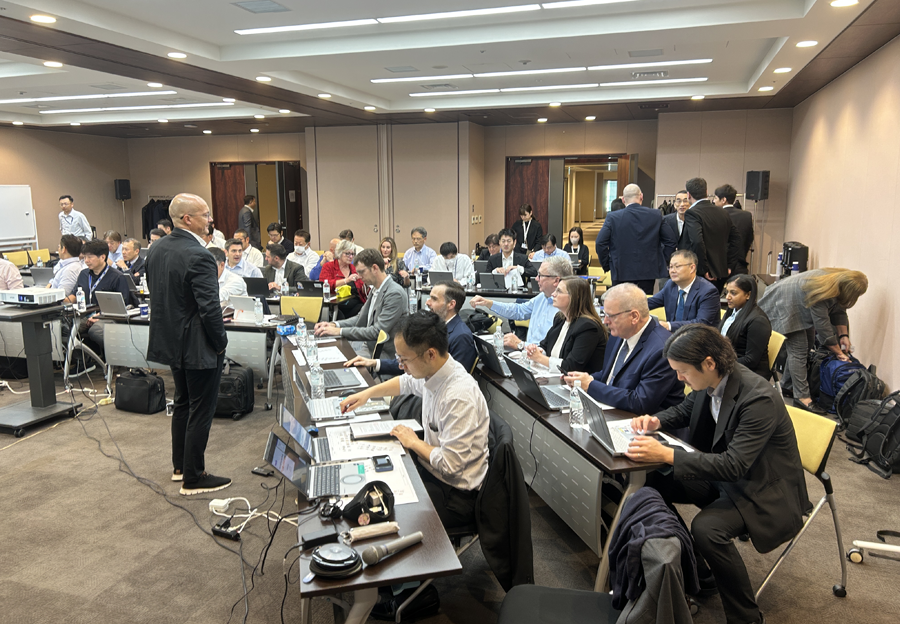
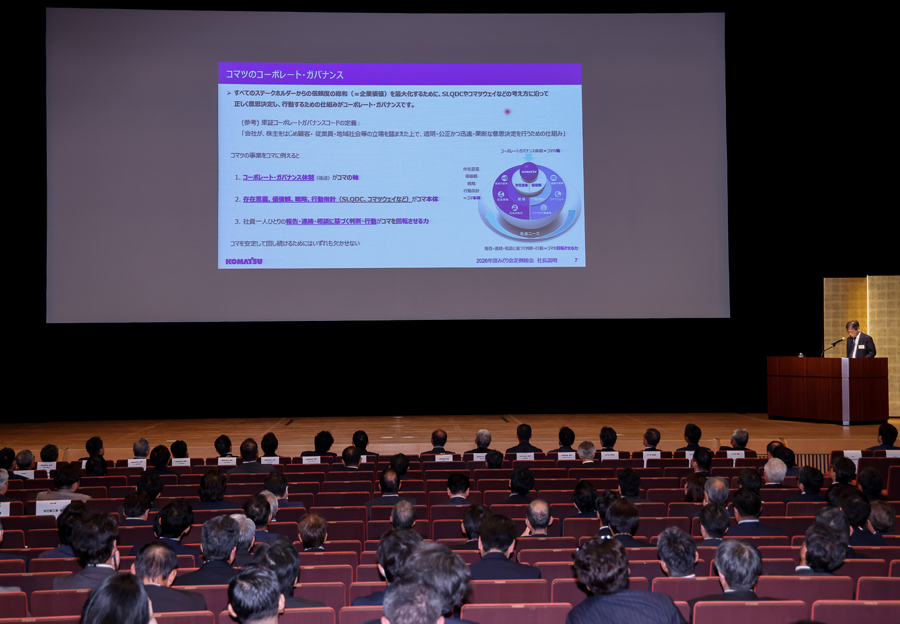
The Midori-kai Management Roundtable, held in Japan every November, is attended by many overseas member companies as well as member companies in Japan. At the meeting, Komatsu management provides an overview of its business and explains its global procurement policy and priority initiatives.
To support member companies in improving their competitiveness, member companies in Japan and China are organized into groups, or subcommittees, according to their industries and the types of items they supply. Each group selects common themes such as safety, the environment and advanced production technologies and works with Komatsu to promote improvement activities. Examples of improvements are shared among companies within the same group and rolled out across the group.
For more information on Komatsu’s initiatives for Midori-kai member companies, please refer to the following page.
Breakdown of critical suppliers
| Area | Number of Critical Suppliers | ||||||||
|---|---|---|---|---|---|---|---|---|---|
| Total | Sub-contracted*1 | Proprietary parts*2 | |||||||
| Invested by Komatsu | Highly dependent on business with Komatsu | Others | Invested by Komatsu | Highly dependent on business with Komatsu | Big enterprise | Trading firms / Materials | |||
| Midori-kai | Japan | 155 | 6 | 86 | 2 | 7 | 43 | 11 | |
| China | 57 | 2 | 37 | 2 | 1 | 4 | 9 | 2 | |
| Thailand | 33 | 19 | 1 | 10 | 3 | ||||
| North America | 46 | 1 | 15 | 6 | 1 | 18 | 5 | ||
| Europe | 30 | 4 | 13 | 11 | 2 | ||||
| subtotal | 321 | 9 | 161 | 21 | 4 | 12 | 91 | 23 | |
| Non Midori-kai | Japan | 1 | 1 | ||||||
| North America | 1 | 1 | |||||||
| Europe | 1 | 1 | |||||||
| Indonesia | 4 | 1 | 1 | 2 | |||||
| India | 18 | 4 | 14 | ||||||
| Vietnam | 4 | 3 | 1 | ||||||
| Philippines | 1 | 1 | |||||||
| subtotal | 30 | 2 | 8 | 0 | 0 | 1 | 17 | 2 | |
| Total | 351 | 11 | 169 | 21 | 4 | 13 | 108 | 25 | |
Classification and breakdown of critical suppliers
| Category | Number and percentage of companies | Percentage of procurement amount | |||
|---|---|---|---|---|---|
| 1 | Total Tier 1 suppliers | 2,553 | 100% | 100% | |
| 2 | Critical suppliers* |
Level-3 | 351 | 14% | 74% |
| 3 | Level-2 | 197 | 8% | 63% | |
| 4 | Level-1 | 15 | 1% | 8% | |