
In April 2019, Komatsu announced its endorsement of the recommendations of the Task Force on Climate-related Financial Disclosures (TCFD). We address climate change by assessing the risks and opportunities that climate change poses to the Komatsu Group, conducting scenario analyses, and engaging in healthy dialogue with stakeholders.
At the 26th session of the Conference of the Parties to the United Nations Framework Convention on Climate Change (COP26), held in November 2021, the parties adopted an agreement to pursue efforts to limit the increase in the global average temperature to 1.5°C above pre-industrial levels. Furthermore, at COP28, held in November and December 2023, it was agreed to accelerate reductions in greenhouse gas emissions, including CO2 emissions, to achieve the 1.5°C target.
In light of these global trends, Komatsu began including a 1.5°C scenario in its analyses in FY2022, in addition to the 2°C and 4°C scenarios used previously. We disclose the results of these analyses annually.
In addition, as part of its framework for addressing climate change-related issues, Komatsu convenes the Sustainability Promotion Committee, chaired by the President, once a year and additionally as necessary. The committee deliberates on and determines sustainability measures across the Group, their progress, policies related to the environment and CSR—including climate change-related issues—and other important measures and activities, while promoting their implementation.
The Sustainability Promotion Committee is responsible at the management level for assessing and managing climate change-related issues, including risks and opportunities. Matters discussed by the committee are reported regularly to the Board of Directors at least once a year. Through oversight and deliberation by the Board of Directors, Komatsu has established a framework to promote the implementation of necessary measures at the management level.
In identifying climate change-related risks and opportunities pertaining to the Komatsu Group’s business, we referenced the risk and opportunity examples described in Final Report: Recommendations of the Task Force on Climate-related Financial Disclosures. The scope encompassed all Komatsu Group businesses, and we identified 16 risks and opportunities, with a particular focus on the construction and mining equipment business, where the impacts are especially significant. We then assessed the internal factors, which impact sales and earnings, and external factors, which are projected by the selected scenarios, and grouped the identified risks and opportunities into the four themes of changes in resource demand, transition to low-carbon products, manufacturing costs, and natural disasters.
Since our first TCFD disclosure in 2020, we have focused on these four themes and updated them annually.
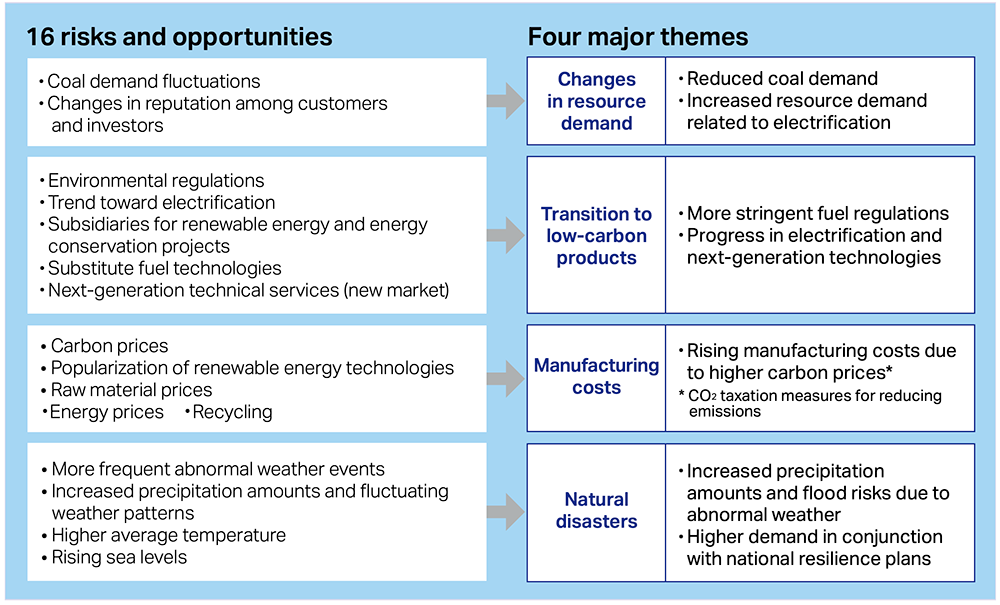
To gauge the potential impacts of climate change-related risks and opportunities on the Komatsu Group’s business, we performed scenario analyses of the aforementioned four major risk and opportunity themes. For these scenario analyses, we selected the 1.5°C scenario, the 2°C scenario, and the 4°C scenario based on the Fifth Assessment Report (Representative Concentration Pathways 2.6 and 8.5) and the Sixth Assessment Report (Shared Socioeconomic Pathways 5-8.5) of the Intergovernmental Panel on Climate Change (IPCC), and the Sustainable Development Scenario, the Stated Policies Scenario*1, and the Net Zero Emissions by 2050 scenario*2 of the International Energy Agency (IEA).
Revision of mining equipment business portfolio in response to shifts in resource demand
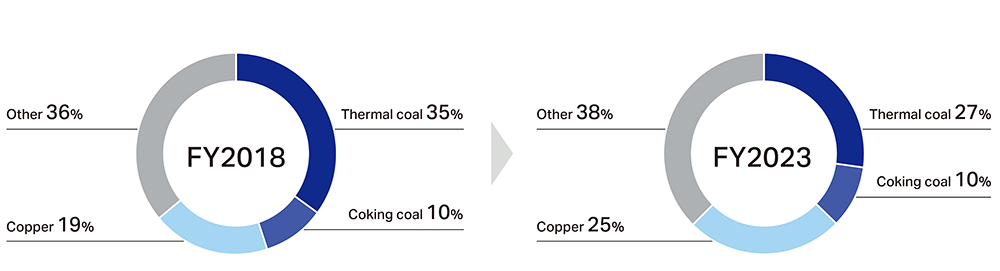
Under the IEA’s Net Zero by 2050 Emissions scenario (1.5°C scenario), demand for coal (soft rock) is projected to decline further as the shift away from coal continues. Conversely, demand is expected to grow for the critical minerals that are imperative to clean energy technologies. Accordingly, the global transition to electrified equipment is anticipated to drive a strong shift in demand toward hard rock minerals like iron, copper, and gold. It is possible that changes in global trends could result in temporary shifts in demand. However, the overall trends in demand are expected to advance in this direction. In response to this shift in demand, the Komatsu Group is revising its mining equipment business portfolio by reorganizing underground soft rock mining equipment production and support systems, while expanding the lineup of underground hard rock mining equipment through M&A activities. As a result of these activities, the portion of net sales associated with thermal coal has gradually decreased and the portion related to copper has increased over the last few years.
Figure: Resource demand projections of IEA’s 1.5ºC scenario (Monetary value basis)
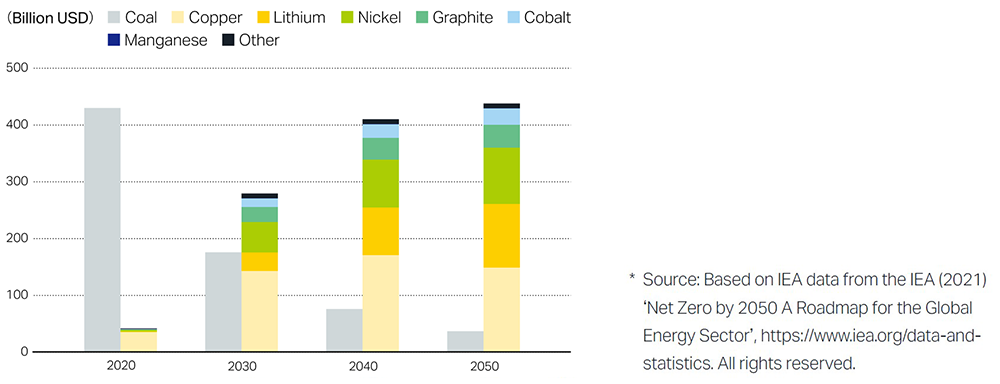
Figure: Ratio of sales of Komatsu mining equipment business by target mineral
Battery strategy for stable development of electric construction equipment
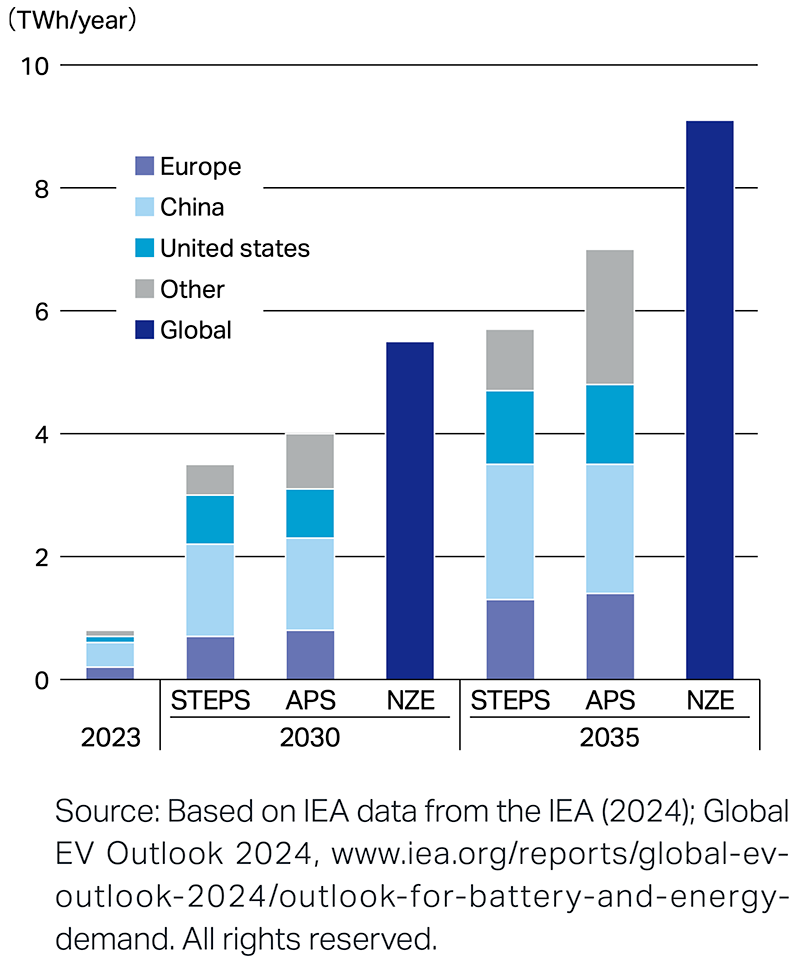
Demand forecast for EV batteries
1. Scenario analysis
Sales of electric vehicles (EVs), including commercial vehicles, cars, and motorcycles, are expected to expand mainly in the United States, Europe, and China. Consequently, demand for EV batteries is also expected to grow rapidly.
(In the STEPS, EV battery demand is projected to increase to 4.5 times the 2023 level by 2030 by 2030 and to nearly 7 times the 2023 level by 2035.)
2. Risks
3. Opportunities
4. Strategy
To develop batteries for construction and mining equipment, Komatsu acquired U.S. battery manufacturer American Battery Solutions, Inc. (ABS) in fiscal 2023, accumulating expertise and insights ranging from battery development to production technology. We are also working with various partners to develop optimal power sources for Komatsu's diverse product lineup of models and sizes. Going forward, we intend to expand the number of models equipped with ABS batteries and also accelerate in-house production of key components related to electric construction equipment, thereby establishing a value chain business that covers the entire lifecycle of electric construction equipment
Scenario analysis: Impact of carbon taxes under the 1.5°C scenario
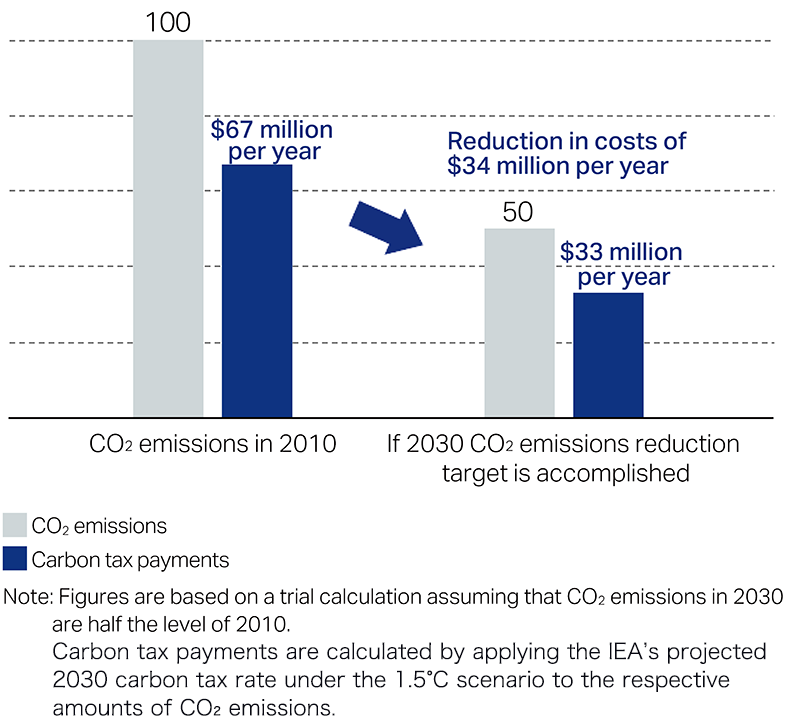
The 1.5°C scenario projects carbon tax rates that are higher than those predicted by the 2°C scenarios, reflecting high tax rates in both developed and emerging countries in 2030 and ongoing increases thereafter. Higher carbon prices as a result of carbon taxes and other government policies present the risk of future increases to manufacturing costs. Conversely, if Komatsu takes action to achieve CO2 emissions reduction targets, these efforts will help lower the costs associated with carbon taxes. Moreover, carbon taxes also influence the prices of fuel used by equipment. Accordingly, Komatsu’s initiatives for developing low-carbon products and otherwise reducing CO2 emissions from product use will contribute to a lower cost burden for customers.
Figure: Projected carbon taxes ($/ton- CO2)
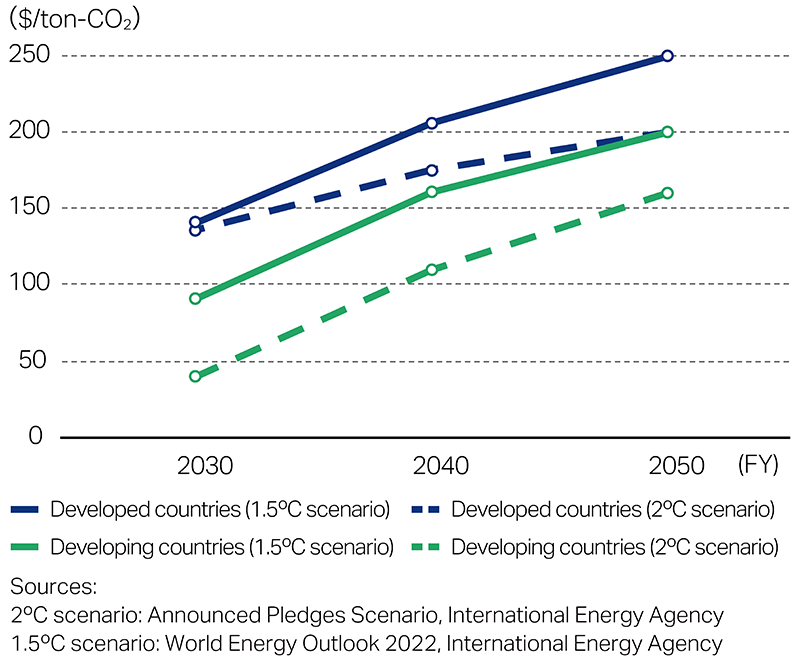
Figure: Carbon tax payments if Komatsu accomplishes CO2 emissions reduction targets for 2030
Predicted increase in frequency and intensity of heavy rainfall by scenario
The Komatsu Group reviews its flood risk surveys every three years and continuously manages risks in light of the progress of climate change. The Group has experienced frequent flood damage at sites in Japan , Indonesia, and elsewhere over the years. Therefore, we conduct regular flood risk surveys to identify high-risk bases and take necessary measures. The IPCC's Sixth Assessment Report predicts that the frequency and intensity of heavy rainfall will increase dramatically in the future as a result of global warming. In response, Komatsu conducted a flood risk study in 2023 to identify high-risk sites and evaluate the financial impact.
1. Scenario analysis: frequency and intensity of 1-in-10-year heavy rainfall events*1
| [Past] 1850-1900 |
[Present] 1°C |
[Future] Level of global warming | |||
|---|---|---|---|---|---|
| 1.5℃ | 2℃ | 4℃ | |||
| Frequency of occurrence per decade (Median) | 1 time | 1.3 times | 1.5 times | 1.7 times | 2.7 times |
| Intensity (atmospheric moistening*2) | +6.7% | +10.5% | +14.0% | +30.2% | |
Global warming 1.5°C projection
Global warming 4°C projection
2. Risks
We used hazard maps and other information to estimate the financial impact of shutdowns at domestic and overseas sites.
| Assumed Damage and Impact |
Financial Impact (single year) Current damage estimates |
Initiatives |
|---|---|---|
| Decrease in sales due to shutdown of production facilities caused by flooding | 20.4 billion yen - 55.3 billion yen*3 |
|
*3 Estimates for overseas bases: We assume inundation depths based on hazard maps for domestic bases. We also incorporated damage coefficients for inundation zones in Japan into the calculations.
3. Opportunities
If global warming progresses and flood damage becomes more severe in the future, responses to national land resilience and other measures may become more active, leading to an increase in demand for construction equipment.